Key takeaways
- 01Helpful content that answers real client questions builds trust and earns durable search visibility that keeps working long after you publish it.
- 02Practice area pages convert, blog articles attract and educate, and linking the two together strengthens both for readers and search engines.
- 03Demonstrate experience honestly and avoid promising outcomes, since attorney advertising rules on testimonials, results, and specialist claims vary by state.
- 04Repurpose each article into video, social, and email so one piece of thinking reaches people across the channels they already use.
- 05Measure conversions by page, not just traffic, and publish on a steady cadence you can sustain alongside your caseload.
Why Helpful Content Earns Trust and Search Visibility
Most people facing a legal problem feel anxious, rushed, and out of their depth. They are not looking for a brochure. They are looking for someone who understands their situation and can explain what happens next in plain language. When your website answers their questions calmly and clearly, you do two things at once. You reduce their fear, and you position yourself as the steady guide who can lead them out of it.
Search engines reward this same behavior. Google has spent years refining how it evaluates pages, and it consistently favors content that demonstrates real experience, expertise, authority, and trust. A thin page stuffed with keywords does not survive long. A genuinely useful page written by someone who clearly practices in the area tends to hold its ground and attract links, shares, and repeat visits over time.
The compounding effect matters here. Unlike a paid ad that stops the moment you stop funding it, a strong article keeps working for months or years. One well written explainer can quietly bring in qualified visitors long after you publish it. That durability is what makes content a foundational part of broader law firm marketing strategies rather than a one time campaign.
Marketing your firm: with a partner or alone
Here is how growing your firm's visibility looks with a partner who knows law firms versus going it alone.
With a partner who knows law firms
- A clear plan built around your practice areas
- Search and content tuned to win local cases
- Ads tracked so you know what they return
- Reporting that respects your profession's rules
Marketing your firm alone
- Guessing at strategy with no roadmap
- Pages that never reach the people searching
- Ad spend with no clear sense of return
- Hours pulled away from practicing law
Answer the Questions Clients Actually Ask
The fastest way to run out of content ideas is to guess. The fastest way to never run out is to listen. Your best material comes directly from the conversations you already have every week. Think about the first ten minutes of a consultation. What does the worried caller want to know before anything else? Those questions are your content calendar.
Start by collecting real questions from real sources. Your intake team hears the same concerns over and over. Your inbox is full of them. Review platforms, community forums, and the People Also Ask boxes in search results all surface the language clients actually use. Notice that people rarely search in legal jargon. They ask how long a case takes, how much it costs, and whether they even have a claim.
Write for that person, not for another attorney. Use the words they use. Answer the question early in the piece instead of burying it under preamble. Then add the context only a practitioner would know, the nuance that turns a generic answer into one that clearly comes from someone who has handled the matter many times.
- Common intake questions your phone team answers daily
- The objections or worries that come up in consultations
- Misconceptions clients arrive with that you have to correct
- Questions clients ask after they hire you, which signal gaps you can fill earlier
Practice Area Pages Versus Blog Articles
These two formats do different jobs, and confusing them weakens both. A practice area page is your core service page. It exists to convert. It speaks to someone who has identified their problem and is comparing options. It should clearly state what you handle, who you help, why your experience matters, and what to do next. It is stable, you update it occasionally, and it sits in your main navigation.
A blog article, by contrast, is built to attract and educate. It targets a specific question or scenario, often earlier in the decision process, and it links inward to the relevant practice area page when the reader is ready to act. Articles are how you cover the long tail of questions that would clutter a service page if you tried to cram them all in.
The strongest sites connect the two deliberately. Imagine a practice area page on personal injury that links out to a cluster of articles answering specific questions, and each of those articles links back to the page. This internal structure, sometimes called a content cluster, helps readers navigate and helps search engines understand which page is the authority on a topic. The page closes the sale. The articles fill the room.
Demonstrate Experience and Authority Responsibly
Your credibility is your most valuable content asset, and also the area where you are most exposed to risk. The instinct to prove yourself is right. The way you do it matters enormously, because attorney advertising rules vary by state and several common content moves can cross a line without you realizing it.
Lead with genuine experience rather than empty superlatives. Describe the types of matters you handle, the courts you appear in, and the kinds of outcomes clients can realistically expect, framed honestly. Anonymized examples and educational walkthroughs build authority without the problems that come from naming clients or implying guaranteed results. Avoid promising specific outcomes, because most jurisdictions treat that as misleading.
Be careful with a few recurring traps. Client testimonials and case results are restricted or require specific disclaimers in many states. Calling yourself a specialist or an expert is regulated where formal certification programs exist. Comparative claims that you are the best can invite scrutiny. None of this means you stay silent. It means you treat your own state bar rules and the model rules they draw from as the baseline you check before publishing anything that touches results, credentials, or comparisons.
When in doubt, run sensitive content past whoever handles compliance at your firm. A short review habit costs little and protects the trust you are working so hard to build.
- Confirm whether your state requires disclaimers on testimonials or past results
- Avoid language that promises or implies a guaranteed outcome
- Use the terms specialist or expert only where you are certified to do so
- Keep an archive of what you published and when, in case you need to show compliance
Repurpose Content Into Video and Social
Writing one good article is an investment. Letting it live in only one place wastes that investment. The smarter move is to treat each piece as raw material that can be reshaped for the places your audience already spends time. The thinking is done once. The packaging changes.
A single explainer can become a short video where you answer the question on camera, a set of social posts that each pull out one practical tip, an email to past clients and referral partners, and a downloadable checklist. Video is especially powerful for lawyers because it lets a prospective client see your demeanor and hear how you explain things, which is exactly what they are trying to evaluate before they call.
You do not need a studio. A quiet room, decent light, and a clear answer to one question are enough to start. The point of distributing across channels is not vanity reach. It is meeting people where they are and reinforcing the same trustworthy message in more than one format. For a deeper look at platform choices and cadence, see our guide to law firm social media.
The Role of Content in Winning Referrals
Referrals are the lifeblood of most healthy practices, and content quietly strengthens every part of that engine. When a past client wants to recommend you, sending a link to a clear, helpful article is far easier than describing what you do from memory. Your content becomes the words they did not have.
The same is true for professional referral sources. Other attorneys who do not handle your type of matter, accountants, financial advisors, and similar contacts all need a quick way to vouch for you. A library of substantive content tells them you take the work seriously and gives them confidence that sending someone your way reflects well on them.
There is also a trust check happening behind the scenes. When someone receives your name as a referral, they almost always look you up before calling. If they find thoughtful, current content that matches the recommendation they just heard, the referral holds. If they find a stale or empty site, doubt creeps in. Content does not replace relationships. It protects and amplifies the ones you already have.
Create Something Useful Beyond Your Next Client
A law firm's content can answer a question for someone who will never hire the firm. That can still be a sound editorial choice. A journalist explaining a local issue, a consumer educator helping people compare options, or another lawyer guiding a client may need a clear resource they can send readers to. The test is whether the resource helps that person complete a task, with its scope and limits visible, even if no consultation follows.
GJEL Accident Attorneys’ California totaled-car value calculator illustrates the idea. It offers a vehicle estimate path and a separate path for reviewing an insurer's total-loss offer. The entry flow asks for a California plate or manual vehicle details, then mileage, ZIP code, and damage photos. GJEL says the tool provides an informational estimate; it is not an appraisal or a guaranteed payout. GJEL also says it does not accept vehicle-damage-only cases. This is a California vehicle property-damage resource, not a way to value an injury claim.
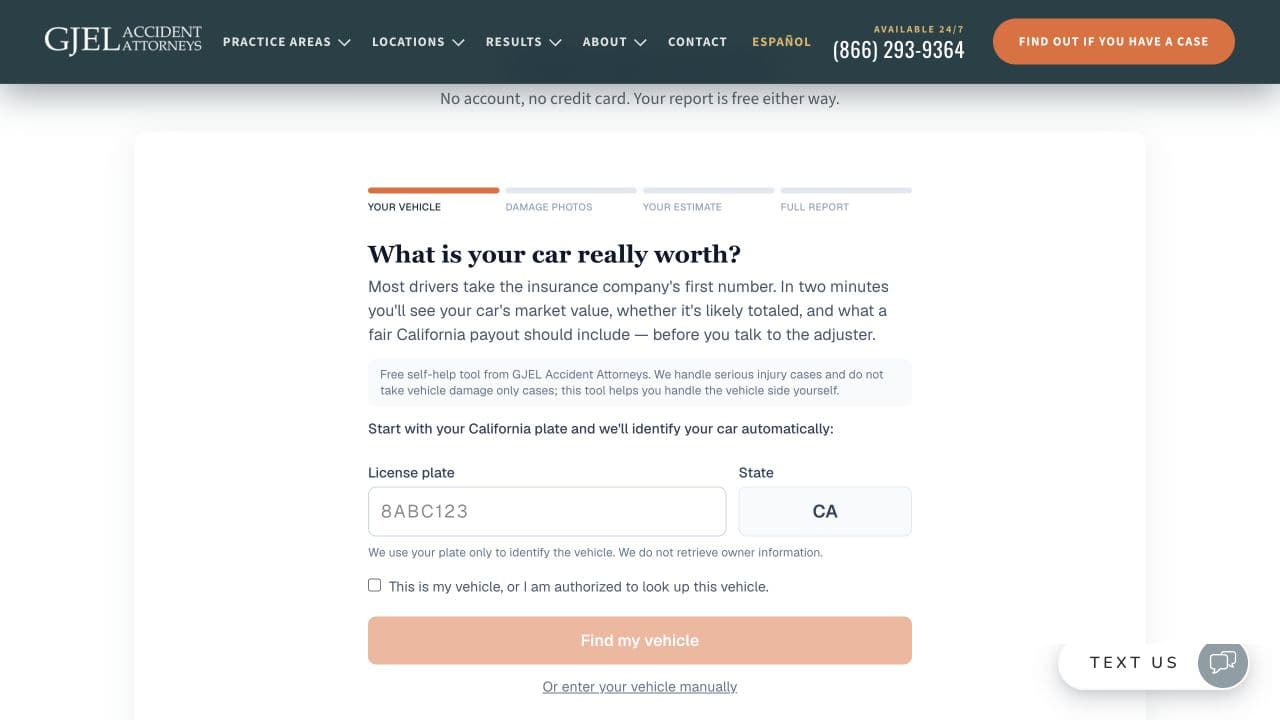
The public use is the reason this example belongs in a content plan. A reporter or consumer educator covering California total-loss questions has a concrete tool to evaluate and potentially reference. A lawyer who does not handle vehicle-only disputes may have a practical resource to share. Neither a useful tool nor a pitch guarantees a mention or link. The firm still has to identify relevant publishers, explain what their audience can do with the resource, give reviewers the jurisdiction and caveats up front, and keep the tool current.
For your own firm, start with a repeated problem your staff sees but your usual service pages do not resolve. Decide what information you can responsibly provide, who else might find it useful, and who will review it when the underlying rules or inputs change. That gives your outreach a specific reason to exist: a resource that helps the recipient serve their readers, rather than a request for a link.
Measure Results and Run a Simple Publishing Plan
Content without measurement turns into guesswork, and guesswork is how firms end up writing about topics that never bring a single case. You do not need a complicated dashboard. You need to watch a handful of signals that connect content to actual business outcomes and review them on a regular rhythm.
Track the metrics that map to revenue, not just traffic. Organic visits tell you whether you are being found. Time on page and scroll depth hint at whether the content is genuinely useful. The numbers that matter most, though, are the ones tied to action: form submissions, calls, and consultations that you can trace back to a specific page. Tag your inquiry sources so you can tell which articles and pages actually drive conversations.
On the publishing side, consistency beats intensity. A firm that publishes one strong piece every two weeks will almost always outperform one that posts ten times in a burst and then goes quiet for a year. Build a plan you can sustain alongside billable work, and revisit older content to keep it accurate as the law and your practice evolve. Content is one channel among several, and it works best when it complements paid efforts such as PPC for lawyers rather than competing with them.
A workable rhythm looks like this for most firms.
- Pick one priority practice area to build out first, then expand
- Publish one helpful article on a clear cadence, such as every two weeks
- Refresh one older page each month so nothing goes stale
- Review conversions by page once a quarter and double down on what produces calls
- Repurpose every new article into at least one video or social format
Common questions
How often should a law firm publish new content?+
Consistency matters far more than volume. A sustainable cadence such as one well researched article every two weeks usually outperforms occasional bursts of activity followed by long silence. Pick a rhythm you can maintain alongside your caseload, and protect time to refresh older pages so they stay accurate.
Can I publish client testimonials and case results on my website?+
Sometimes, but proceed carefully. Rules on testimonials and past results vary by state, and many jurisdictions require specific disclaimers or restrict implying that past outcomes predict future ones. Check your own state bar advertising rules before publishing this kind of content, and ask whoever handles compliance at your firm to review it.
What is the difference between a practice area page and a blog article?+
A practice area page is a stable service page built to convert someone who already knows their problem. A blog article targets a specific question, usually earlier in the decision process, and is built to attract and educate. Articles link inward to the relevant practice area page when the reader is ready to act.
How do I know if my content is actually working?+
Look beyond traffic. The signals that matter are tied to action, such as form submissions, phone calls, and booked consultations you can trace to a specific page. Tag your inquiry sources, review conversions by page each quarter, and invest more in the pieces that produce real conversations.
Do I need video and social media, or is written content enough?+
Written content is the foundation, but repurposing it into video and social extends its reach with little extra effort. Video is especially valuable for lawyers because it lets a prospective client see how you explain things before they ever call. Start simple and reuse the thinking you already did in your articles.